
You have run out of floor space, so you add another shelf.
Then another. Then another.
Now your storage is stacked high, items sit on top of each other, and you need a ladder just to access what used to be simple. Search time grows. Damage increases. Your team spends more time climbing and hunting than doing the work that actually moves the operation forward.
This is the “one more shelf” trap, and it is a sign your space planning approach needs to change.
When you hit this point, it is time to evaluate vertical lift modules and stop treating square footage like the only lever you have.
The shelf-stacking ceiling shows up sooner than you think
Most warehouse and industrial storage areas hit a practical shelf-stacking limit at about eight to ten feet. Beyond that, ladders, lifts, and extra handling become unavoidable. Labor becomes inefficient. Safety becomes a liability.
At that point, you have two options:
- Expand the footprint, which increases cost and often requires approvals
- Change the approach and use the building height you already have
This is where vertical lift modules change the storage math.
What vertical lift modules actually do
Vertical lift modules shift storage from “people go to inventory” to “inventory comes to people.”
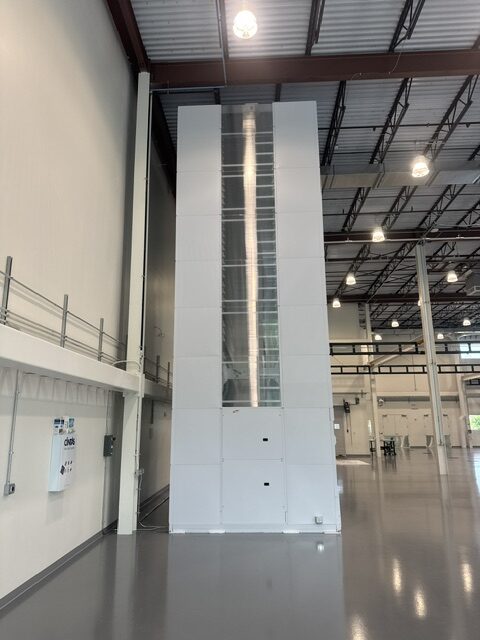
A vertical lift module is a tall enclosed cabinet, often 10 to 20 feet high, with dense internal trays. Instead of walking aisles and climbing to reach parts, the system retrieves the tray and presents it at a comfortable working height.
This matters because it changes daily performance:
- Retrieval happens at a consistent working height, so ladders are not part of the process
- Search time drops because locations are system-managed, not memory-based
- Density increases because you use vertical volume instead of expanding aisles
- Safety improves because you reduce climbing and overhead handling
- Inventory control tightens because movement can be tracked and logged
If your operation is feeling squeezed, vertical lift modules are often the cleanest way to gain capacity without changing the footprint.
The density math is why vertical lift modules keep winning
Traditional shelving uses a lot of floor area because aisles are permanent and access is manual. Vertical lift modules use a smaller footprint and convert more of the room into usable storage.
A common comparison looks like this:
- Traditional shelving can require hundreds of square feet to achieve a certain number of storage positions
- A vertical lift module can often deliver similar or greater storage density in a much smaller footprint by using height and tray density
That freed floor space becomes usable real estate for staging, kitting, packing, and safer movement.
When a VLM make financial sense
It is true that vertical lift modules cost more upfront than adding shelves. That is not the comparison that matters.
The better comparison is what you spend every day on wasted motion, searching, errors, and space constraints.
The ROI equation typically includes:
- Floor space savings and the value of reclaimed operational area
- Labor efficiency from reduced travel and faster retrieval
- Inventory accuracy improvements when the system tracks where things live
- Safety improvements from reduced climbing and overhead lifting
- Scalability as volume grows without requiring more aisles and more footprint
For dense parts environments, the math often shifts quickly in favor of vertical lift modules, because small inefficiencies compound at high frequency.
Parts rooms are the classic VLM win
If you manage a maintenance parts room, manufacturing supply store, or technical equipment library, you already know the cost of downtime.
The reason vertical lift modules fit parts rooms so well is simple:
- Parts are small, counts are high, and space is always tight
- Retrieval must be fast because every minute waiting can stop production
- Accuracy matters because the wrong part creates more work and more delays
- Organization matters because chaos in a parts room cascades into broken operations
A well-planned parts room with vertical lift modules turns storage into a controlled process instead of a scavenger hunt.
 The workflow transformation is what people notice first
Traditional parts workflow often looks like this: someone walks to storage, hunts through bins, grabs what they think is right, then walks back and discovers it was wrong.
A vertical lift module’s workflow is different: the user requests the item, the system presents the tray, the user confirms and removes it, and the system logs the movement.
This is why retrieval time and error rates can drop dramatically. When inventory comes to the operator, the process becomes repeatable and less dependent on who knows the room best.
Multi-shift operations benefit even more
If your facility runs multi-shift or 24/7, the value of consistency increases.
Different shifts do not have to “learn” the room or waste time searching after handoffs. The system manages location, access, and accountability. The more frequently the system is used, the faster the return on vertical lift modules tends to show up.
When a VLM is not the right answer
Be honest about the fit. Vertical lift modules are not for every storage profile.
They may not be the best choice if you have:
- Low-volume, low-density inventory with plenty of space
- Infrequent access where items sit for weeks
- Very large items that will not fit in trays
In those cases, better organization and optimized shelving may be the smarter move.
But if you are adding shelves just to make things fit, if retrieval time is climbing, or if labor costs are rising because of search inefficiency, it is time to evaluate vertical lift modules.
Make the VLM decision with data
Before committing, audit the operation:
- How many items are you storing?
- How often is each item accessed?
- How much time does retrieval take today?
- How much floor space is being consumed by storage?
- What is the growth trajectory?
This is the data that tells you whether vertical lift modules will pay back quickly or whether you simply need a better shelving and layout plan.
O’Brien Systems designs and installs vertical lift solutions for warehouses, parts rooms, and high-density operations, and can help you model ROI and determine the best approach for your space.
Stop adding shelves and start using height
The “one more shelf” trap is a warning. It is your operation telling you that the storage approach has reached its limit.
When you are ready to reclaim floor space, reduce search time, and improve safety, vertical lift modules are often the next logical step.
Book a vertical storage demo to evaluate whether vertical lift modules fit your inventory profile, throughput, and space planning goals.